> For the complete documentation index, see [llms.txt](https://experience-digital-transform.gitbook.io/experience-digital-transformation/llms.txt). Markdown versions of documentation pages are available by appending `.md` to page URLs; this page is available as [Markdown](https://experience-digital-transform.gitbook.io/experience-digital-transformation/cloud-for-dpi/chapter-4/why-kubernetes.md).

# Why Kubernetes

A **virtual machine** provides an operating system, CPU, memory and network interfaces. It does not place application processes, maintain copies or roll out new versions.

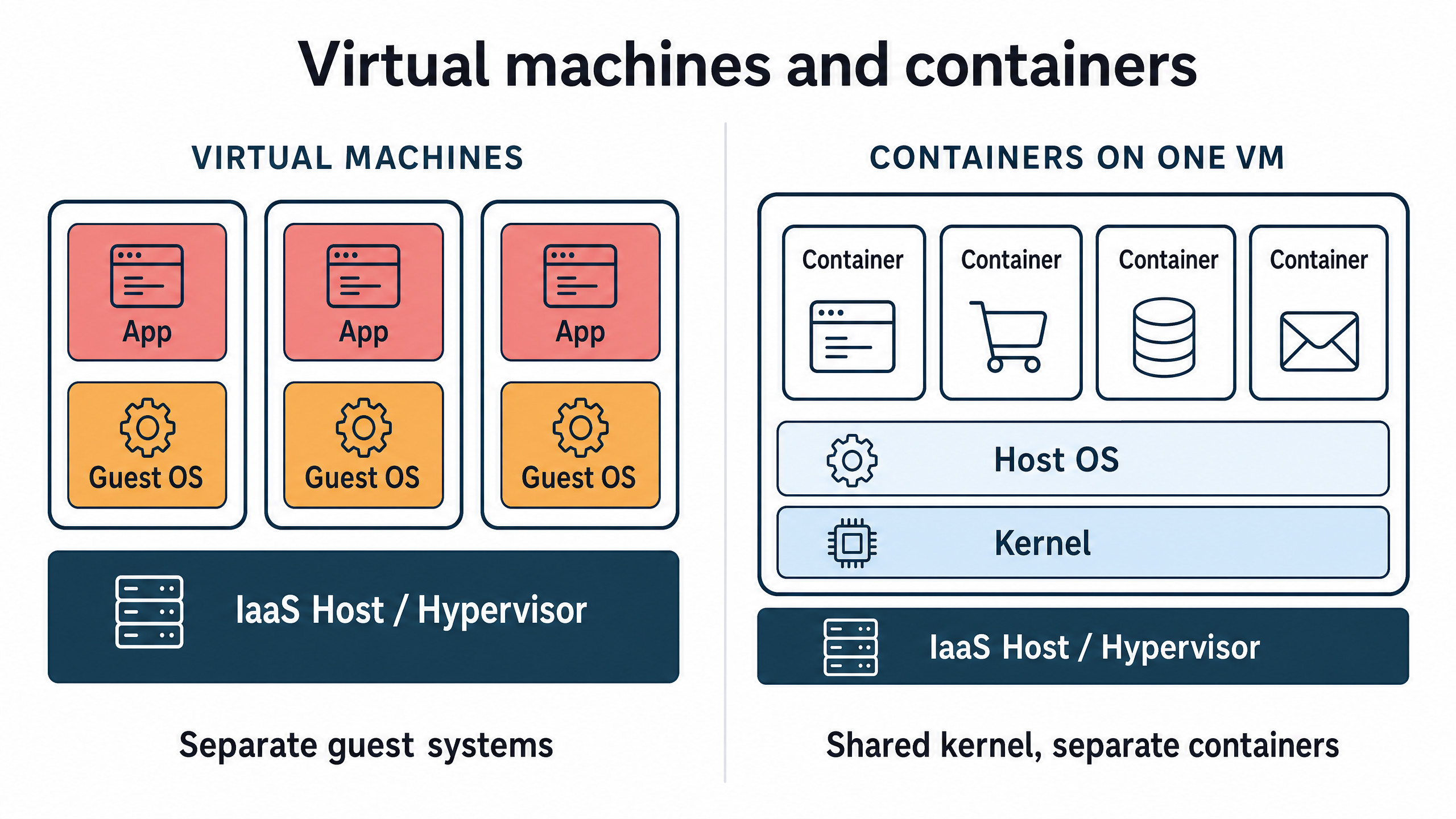
**Containers** change the packaging unit. A **container image** carries an application and its userspace dependencies, while containers normally share the host kernel. One virtual machine can run several isolated containers without a guest operating system for every copy. Workload behaviour, security and isolation still determine the suitable boundary. [\[19\]](https://csrc.nist.gov/pubs/sp/800/190/final)

<figure><img src="https://1406653965-files.gitbook.io/~/files/v0/b/gitbook-x-prod.appspot.com/o/spaces%2FkZFMZ3jCMUwHtTN0sL4J%2Fuploads%2Fgit-blob-267741292bb18b2273730f46be3a22fdc5ca5cd2%2Ffinal.png?alt=media" alt="Several virtual machines each package an application with a guest operating system, while one virtual machine can host several containers above a shared kernel."><figcaption><p>Figure 1. Virtual machines isolate complete guest systems. Containers let several packaged applications share one host kernel while retaining separate runtime boundaries.</p></figcaption></figure>

**Kubernetes** adds a common lifecycle system for containers. Its smallest deployable workload unit is a **Pod**, which holds one or more tightly related containers. A **Node** is a machine that can run Pods. A **Deployment** states the desired number of interchangeable application copies and the update strategy. A **Service** gives a changing set of Pods a stable network identity. [\[9\]](https://kubernetes.io/docs/concepts/services-networking/service/)[\[16\]](https://kubernetes.io/docs/concepts/workloads/controllers/deployment/)[\[18\]](https://kubernetes.io/docs/concepts/workloads/pods/)

The Kubernetes **scheduler** selects eligible Nodes for Pods. **Controllers** compare **declared state** with **observed state**. They can replace a failed Pod when capacity exists; missing Node capacity still requires the infrastructure lifecycle. [\[14\]](https://kubernetes.io/docs/concepts/overview/)[\[15\]](https://kubernetes.io/docs/concepts/overview/components/)

**Video companion:** [C4-I1, From virtual machines to a Kubernetes platform](https://git.vanillacore.net/giga/content/src/branch/main/chapter-4/VIDEO_SCOPES.md#c4-i1-from-virtual-machines-to-a-kubernetes-platform)

Kubernetes is a workload platform above IaaS. Teams use Kubernetes resources, while storage, load balancing, failure domains, accelerators and capacity still depend on IaaS capabilities.


---

# Agent Instructions
This documentation is published with GitBook. GitBook is the documentation platform designed so that both humans and AI agents can read, navigate, and reason over technical content effectively. Learn more at gitbook.com.

## Querying This Documentation
If you need additional information that is not directly available in this page, you can query the documentation by asking a question.

Perform an HTTP GET request on the following URL with the `ask` and `goal` query parameters:

```
GET https://experience-digital-transform.gitbook.io/experience-digital-transformation/cloud-for-dpi/chapter-4/why-kubernetes.md?ask=<question>&goal=<user_goal>
```

`ask` is the immediate question: it should be specific, self-contained, and written in natural language.
`goal` is what the user is ultimately trying to achieve, the reason they need the answer. Sharing it helps GitBook give you a better, more relevant answer. A goal is most helpful when it describes the outcome the user wants rather than restating the question. For example, with `ask=how do I create an API token`, a goal like `automate deployments from our CI pipeline` lets GitBook tailor the answer to that use case.

The response will contain a direct answer to the question and relevant excerpts and sources from the documentation.

Use this mechanism when the answer is not explicitly present in the current page, you need clarification or additional context, or you want to retrieve related documentation sections.
